How It Works
다운로드
포커스 모드
폰트 크기
This document describes how Application Load Balancer (ALB) works, helping you gain an in-depth understanding of its working mechanism and architectural design.
Basic Architecture
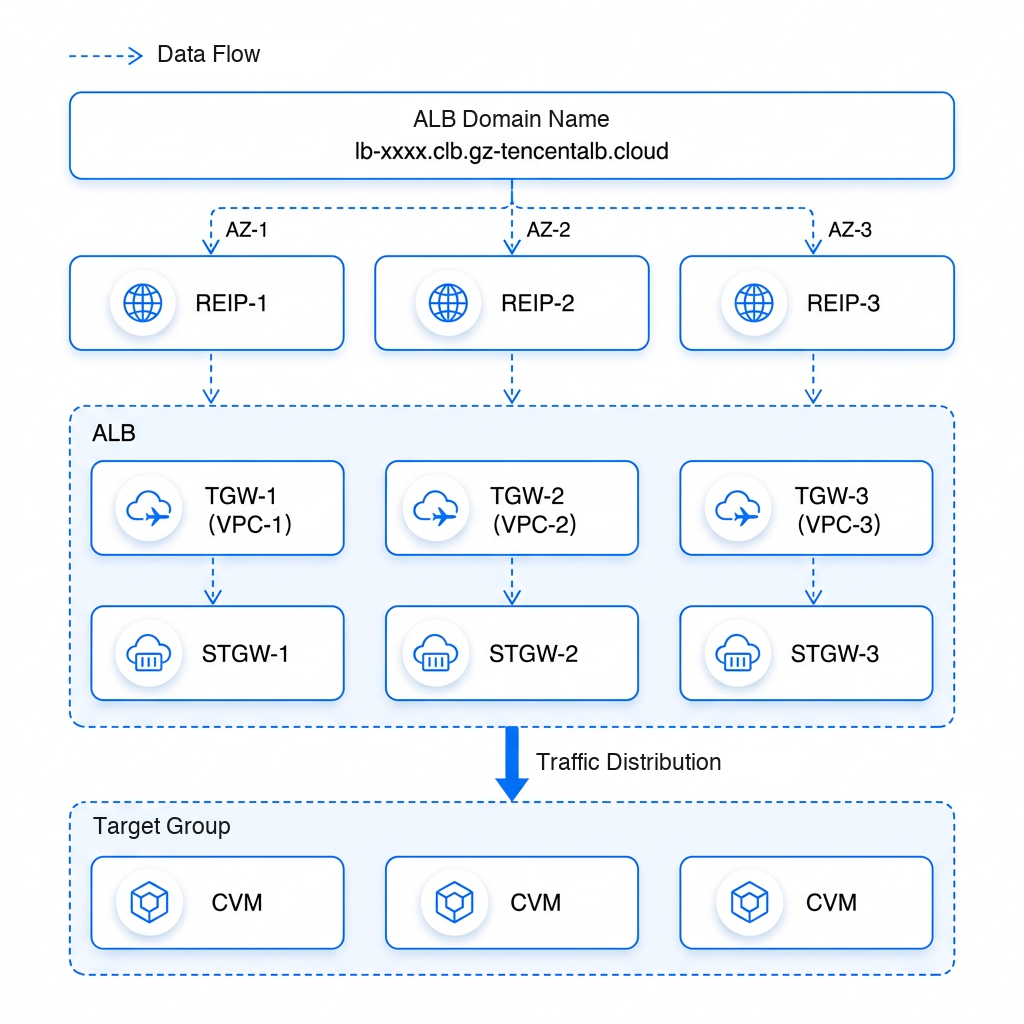
ALB is built on self-developed Secure Tencent Gateway (STGW), which runs Nginx. It implements load balancing, supports tens of millions of concurrent connections, and delivers high-concurrency traffic processing capabilities.
It supports multi-cluster deployment and session status synchronization. This helps reduce the risk of single points of failure (SPOFs) and improve service availability.
It supports multi‑active deployment across availability zones (AZs), achieves high availability (HA) for the traffic ingress via a TGW virtual IP address (VIP), and provides elastic public network access via Elastic IP (EIP).
Both TGW and STGW clusters support cross-AZ disaster recovery (DR).
HA Design
ALB supports cross-AZ deployment. When you create an instance, select subnets in at least 2 different AZs to achieve AZ-level DR.
If a single AZ fails, VIPs in other AZs can still provide services normally.
Traffic is automatically distributed across multiple AZs to improve overall throughput.
Real servers can also be deployed across AZs to avoid service interruptions in a single AZ.
References
피드백