Comparison of ES and Common Vector Database Capabilities
Download
Focus Mode
Font Size
As a leader in the search domain, ES has evolved from full-text search into an AI-powered search engine that supports hybrid text-vector search, and natively supports vector search technology at the Lucene and ES kernel levels.
ES's core advantages lie in its technology stack that simultaneously supports text search, vector search, aggregation analysis, and AI integration. This avoids the issues introduced by hybrid technology stacks, such as system complexity, high costs, difficult debugging and tracing, and high Ops investment, and also reduces the reliability assurance and security challenges associated with multi-system collaboration. Tencent Cloud has performed in-depth self-developed optimization on the open-source ES, covering aspects like hybrid search, fusion ranking, inference performance, cost optimization, and multimodal capabilities, making Tencent Cloud Elasticsearch Service (ES) a reliable, enterprise-grade technology foundation for the AI-powered search era.
In contrast, the advantages of traditional vector databases mostly focus on storage and search in pure vector scenarios. They lack full-text search, aggregation analysis, and out-of-the-box AI integration capabilities. Although some vector databases support text search, they mostly implement it through sparse vector methods, lacking text position information and unable to achieve basic search capabilities such as phrase queries. For example, when "climate change" is queried, the text search implemented via sparse vectors assigns the same score to both "Climate change is a global issue" and "The climate in this place changes every year".
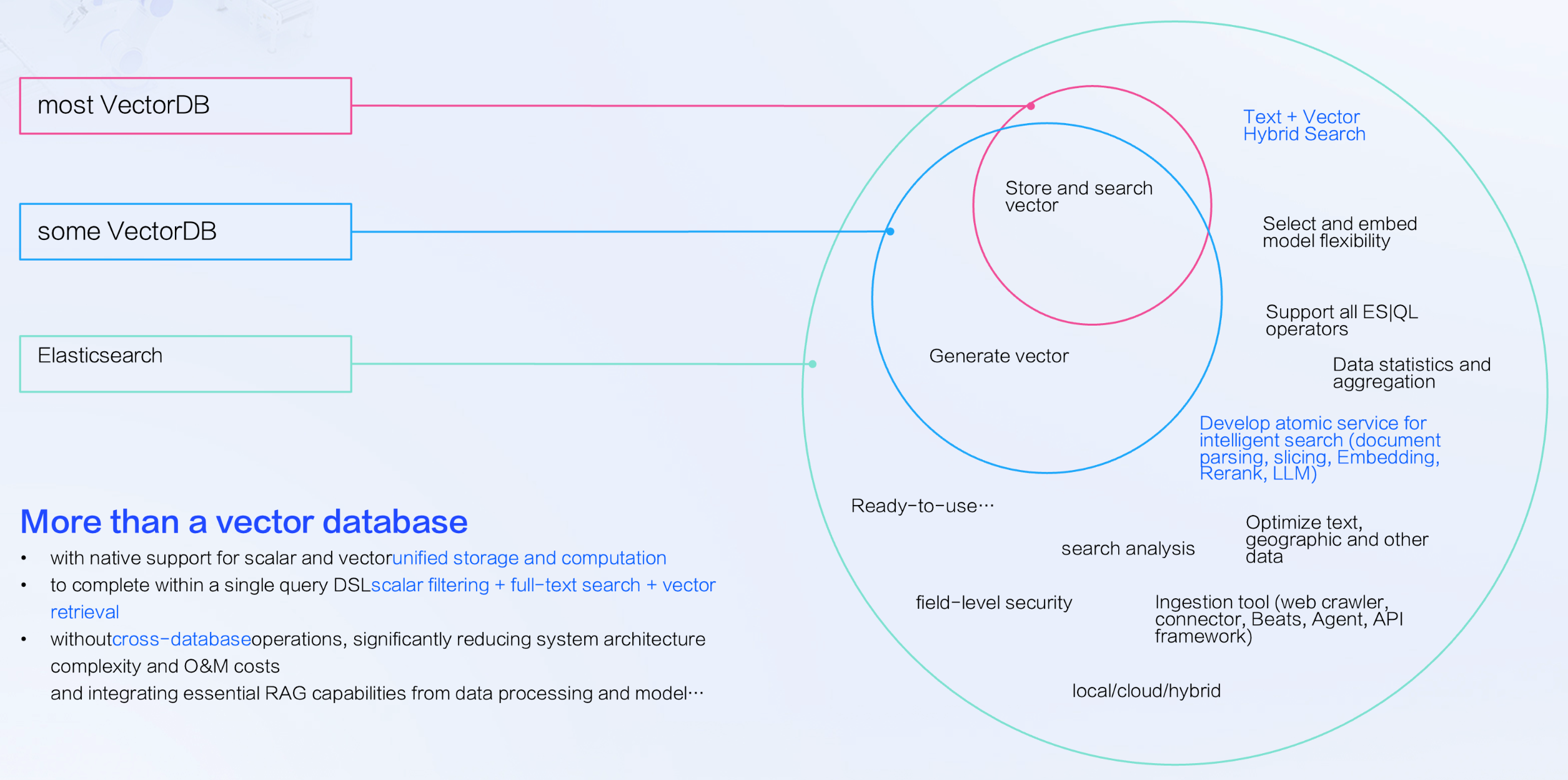
Comparison of ES and Traditional Vector Database Capabilities
1. Basic Capabilities
Comparison Dimension | Tencent Cloud ES | Milvus | Other Vector Databases |
Positioning | Preferred choice for text and vector hybrid search | More suitable for pure vector search scenarios | More suitable for pure vector search scenarios |
Vector engine implementation | Implemented at kernel level | Implemented at kernel level | Implemented at kernel level or via plugins |
Capability scope | Search: Vector search Text search (full-featured) Geographic search Analysis: aggregation analysis AI integration: Built-in model inference One-stop Retrieval-Augmented Generation (RAG) building | Search: Vector search Text search (limited) Geographic search Analysis: x (not supported) AI integration: x (dependent on third-party services) | Search: Vector search None or simple filtering Geographic search: x (not supported) Analysis: x (not supported) AI integration: x (dependent on third-party services) |
Query language and API | Single DSL syntax for all queries | APIs/SDKs, with less flexibility for complex queries than ES | - |
Permission control | Level: index/document/field | Level: table level only | Level: generally table level only |
Learning and Ops | Relatively gentle learning curve | Requires understanding of its unique architecture, with a steeper learning curve | - |
Open-source ecosystem | Active and mature, offering end-to-end solutions covering data ingestion, management, security, and observability | Focuses on the core vector engine, requiring users to integrate tools themselves to implement a solution | - |
2. Vector Search Capabilities
Comparison Dimension | Tencent Cloud ES | Milvus | Other Vector Databases |
Performance | Billions to hundreds of billions of vectors, millisecond-level average response | Billions to hundreds of billions of vectors, millisecond-level average response | Billions to hundreds of billions of vectors, millisecond-level average response |
Vector - index type | FLAT, HNSW, DiskBBQ (9.2), and so on | FLAT, HNSW, IVF, DiskANN, and so on | Generally supports FLAT, HNSW, IVF, and so on |
Vector - quantization (memory saving) | Supports scalar quantization and binary quantization | Supports scalar quantization and binary quantization | Partially supports quantization |
Vector - distance algorithm | L2_NORM, COSINE, DOT_PRODUCT, and MAX_INNER_PRODUCT | L2, IP, COSINE, JACCARD, and HAMMING | Supports mainstream distance algorithms |
Vector - multiple vectors per table | Yes | Yes | Mostly yes |
Vector - multiple vectors per field | Yes | Yes | Generally not supported |
3. Text Search Capabilities
Comparison Dimension | Tencent Cloud ES | Milvus | Other Vector Databases |
Chinese word segmentation | Yes | Yes | Supported by some |
English word segmentation | Yes | Yes | Supported by some |
Other multilingual word segmentation | Yes (extensive) | Limited | Mostly not supported |
Multiple types per field | Yes | No | Mostly not supported |
Synonym | Yes | No | Mostly not supported |
Stopword | Yes | Yes | Generally supported |
Custom plugin | Yes | No | Mostly not supported |
Custom dictionary | Yes | No | Mostly not supported |
Spelling error support | Yes | No | Mostly not supported |
Highlight support | Yes | Yes | Mostly not supported |
Custom relevance scoring | Yes, function_score | No | Mostly not supported |
Full-text search | Yes (full-featured inverted index with BM25 scoring) | Yes (implemented through sparse vectors without positional information) | Mostly not supported |
Phrase search | Yes | Yes (filtering only/no scoring) | Mostly not supported |
NGram search | Yes | Yes | Mostly not supported |
Custom script sorting | Yes (script_score combined with user profiles, click behaviors, and so on) | No | Mostly not supported |
4. Hybrid Search Capabilities
Comparison Dimension | Tencent Cloud ES | Milvus | Other Vector Databases |
Pre-filtering | Yes | Yes | Supported by some |
Post-filtering | Yes | No | Supported by some |
Multi-way merging | Yes | Yes (complex code) | Supported by some |
Custom weighting | Yes | Yes | Mostly not supported |
RRF fusion ranking | Yes | Yes | Mostly not supported |
Rerank semantic ranking | Yes | Yes | Mostly not supported |
Pre-filtering algorithm optimization | Yes | Yes | Supported by some |
Geographic search | Yes | Yes | Mostly not supported |
5. Aggregation Analysis
ES supports multi-level analysis capabilities, which are one of its core advantages. Basic metric aggregations can quickly calculate statistics such as sums, averages, and distinct counts, providing a macro business overview. The more powerful bucket aggregation mechanism can intelligently group data by time intervals, numerical ranges, geographic locations, or specific terms, acting as a multi-dimensional classification framework for your data. Pipeline aggregations further process aggregation results and support advanced analyses like moving averages and derivative calculations, enabling higher-level capabilities such as trend prediction.
Comparison Dimension | Tencent Cloud ES | Milvus | Other Vector Databases |
Aggregation analysis | Yes | No | Mostly not supported |
6. AI Integration Capabilities
Comparison Dimension | Tencent Cloud ES | Milvus | Other Vector Databases |
Atomic service | Yes (self-developed) (parsing, chunking, vectorization, reranking, LLM, and so on) | Dependent on third-party inference services | Mostly not supported |
Custom model inference | Yes Machine learning nodes (vectorization, reranking, and so on) | No | Mostly not supported |
GPU-based inference | Yes (self-developed) NVIDIA GPUs or domestic GPUs such as Zixiao (cost-effective) | Dependent on third-party inference services (higher costs) | Mostly not supported |
One-stop RAG building experience | Yes (self-developed) | No | Mostly not supported |
Help and Support
Was this page helpful?
You can also Contact sales or Submit a Ticket for help.
Help us improve! Rate your documentation experience in 5 mins.
Feedback