Migration Operation Guide
ダウンロード
フォーカスモード
フォントサイズ
Scenarios
This document introduces how to use the DTS data migration feature to migrate data from TencentDB for KeeWiDB to TencentDB for KeeWiDB Storage Edition.
Preparations
1. Establish the access channel between DTS and the database in advance according to the type of access you need. For detailed instructions, see Network Preparation Overview.
Internet Data Center (IDC) self-built databases/Databases of other cloud vendors: The access method can be set to Public Network, Direct Connect (DC), VPN Access, and Cloud Connect Network (CCN).
During migration, ensure that the service of the source instance is accessible in the public network environment and maintain the stability of the public network connection. Network fluctuations or failures may cause the migration to fail. If a failure occurs, you need to re-initiate the migration task.
Self-built databases on Cloud Virtual Machine (CVM) instances: The access method can be set to Self-Built on CVM.
Tencent Cloud database instances: The access method can be set to Database.
Operation Steps
Step 1: Creating a Migration Task
1. Log in to the DTS console, select the Data Migration page, and then click Create Migration Task on the right.
2. On the New Migration Task page, configure the task creation parameters, and then click Buy Now.
Configuration Parameter | Description |
Service Type | Select Data Migration. |
Creation Mode | Create new task: Create a task. Create similar task: Create a task with the same configuration as the historical task quickly. The settings of the new task, such as the database type, access method, billing mode, and migration type, are pre-populated to match the historical task. Users can also modify these settings as needed. |
Billing Mode | Only the pay-as-you-go mode is supported. |
Source Instance Type | Select based on your source database type. It cannot be modified after purchase. In this example, KeeWiDB is selected. |
Source Instance Region | Select the region where the source database is located. |
Target Instance Type | Select based on your target database type. It cannot be modified after purchase. In this example, KeeWiDB Storage Edition is selected. |
Target Instance Region | Select the region where the target database is located. |
Edition | Currently, only NewDTSV3 is supported. |
Specification | Currently, only Xlarge is supported. |
Tag | Set tag keys and values for migration tasks to facilitate efficient management of multiple tasks through tags. |
Task Name | Set it to Name After Creation. The task name is the same as the task ID by default. After the migration task is created, the task name can be reset. Set it to Name Immediately. Enter the task name in the input box below. |
Terms of Service | |
Quantity | Up to 10 migration tasks can be purchased in a single transaction. |
3. After the purchase is completed, you will be automatically redirected to the data migration task list.
Step 2: Configuring Source and Target Databases
1. In the data migration task list, locate the newly created task and click Configure in the Operation column.

2. On the Set source and target databases tab, enter the information about source and target databases, and then click Test Connectivity. After connectivity testing, click Save to proceed to the next step.
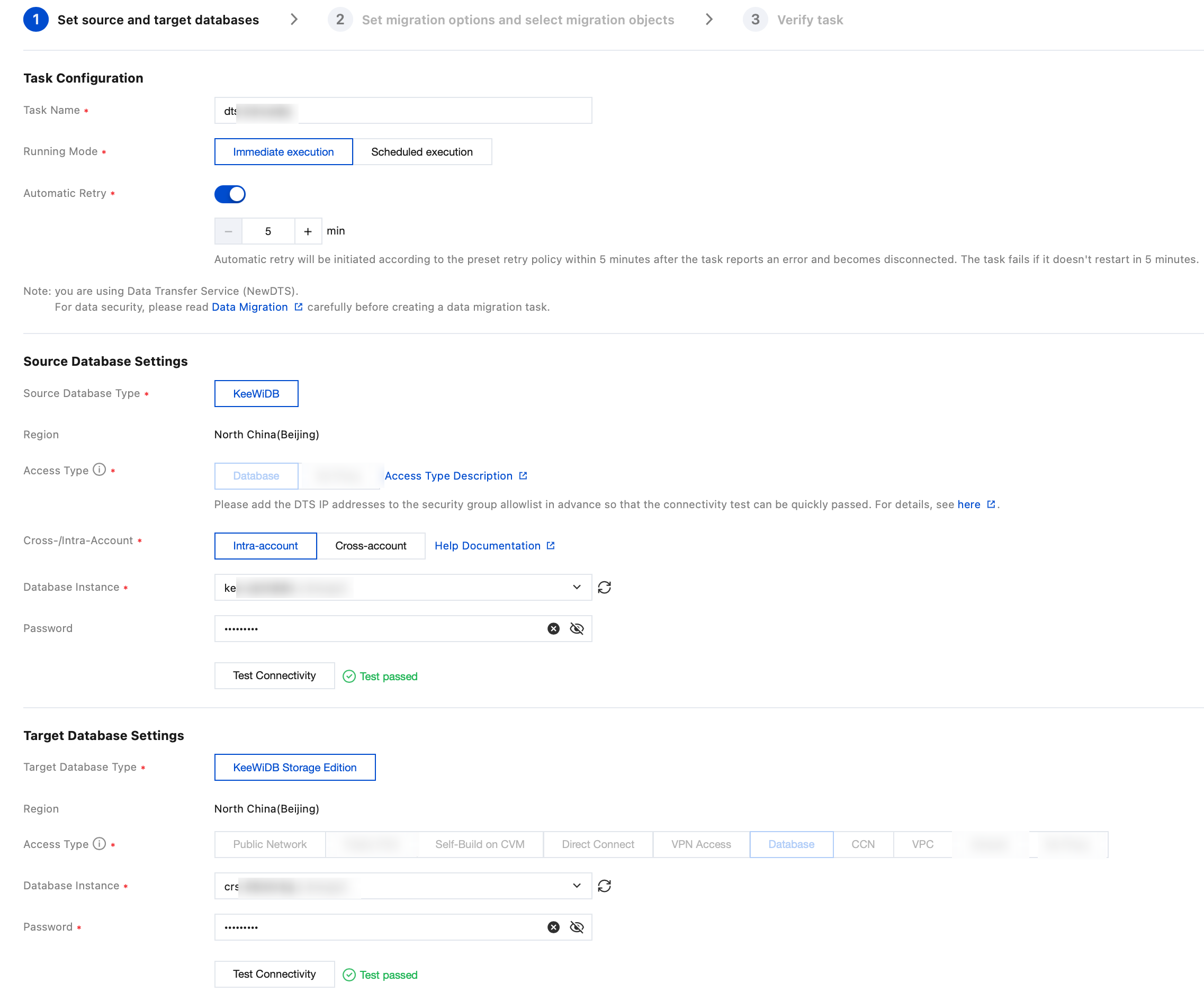
Task Configuration
Configuration Parameter | Description |
Task Name | Specify a business-relevant name to facilitate task identification. |
Running Mode | Immediate execution: The task will be started immediately once the pre-check passes. Scheduled execution: Set a start time for the task execution. After the pre-check passes, the task is not started immediately, but is started at the scheduled time. |
Automatic Retry | After this option is selected, if the migration task is interrupted due to network anomalies or other reasons, DTS will automatically retry within the preset time range without requiring manual user operation.
The retry mechanism is to restart the data migration from the beginning. During the re-migration, the data that has already been migrated to the target database will be cleared or overwritten. |
Source Database Settings
Configuration Parameter | Description |
Source Database Type | Source database type selected during purchase. It cannot be modified. |
Region | Source database region selected during purchase. It cannot be modified. |
Access Type | Currently, only Cloud Database is supported. |
Cross-/Intra-Account | Intra-account: The Tencent Cloud root account for both the source and target database instances is the same. Cross-account: The Tencent Cloud root accounts for the source and target database instances are different. In this example, migration within the same account is performed. For guidance on cross-account migration operations, see Migration Between Cross-Account Cloud Database Instances. |
Database Instance | Select the ID of the source database instance. |
Password | Specify the password for the source database migration account. |
Target Database Settings
Configuration Parameter | Description |
Target Database Type | Target database instance type selected during purchase. It cannot be modified. |
Region | Target database instance region selected during purchase. It cannot be modified. |
Access Type | Select the network type for the target database to access Tencent Cloud. Different access types require different network configuration operations. For details, see Network Preparation Overview. If the target database is an IDC self-built database or a database of other cloud vendors, you can set the access type to Public Network, Direct Connect, VPN Access, or CCN. Public Network: The target database is accessible through a public IP address. Direct Connect: The target database can connect to a Tencent Cloud Virtual Private Cloud (VPC) network through Direct Connect. VPN Access: The target database can connect to a Tencent Cloud VPC network through VPN Connections. CCN: The target database can connect to a Tencent Cloud VPC network through CCN. The target database is a self-built database on CVM: The access method can be set to Self-Built on CVM. The target database is a Tencent Cloud database instance: The access method can be set to Database. |
Public Network | When Access Type is set to Public Network, the following parameters are required to be configured. Host Address: Specify the IP address or domain name of the target database. Port: Specify the port used by the target database. Password: Specify the password for the target database migration account. |
Self-Built on CVM | When Access Type is set to Self-Built on CVM, the following parameters are required to be configured. CVM Instance: Specify the CVM instance ID. Port: Specify the port used by the target database. Password: Specify the password for the target database migration account. |
Direct Connect | When Access Type is set to Direct Connect, the following parameters are required to be configured. VPC-Based Direct Connect Gateway: Only the VPC Direct Connect gateway is supported for DC. Confirm the network type associated with the gateway. VPC: Select a VPC network and a subnet. Host Address: Specify the IP address of the target database. Port: Specify the port used by the target database. Password: Specify the password for the target database migration account. |
VPN Access | When Access Type is set to VPN Access, the following parameters are required to be configured. VPN Gateway: Select the VPN gateway instance that enables connectivity to the network of the target database. VPC: Select a VPC network and a subnet. Host Address: Specify the IP address of the target database. Port: Specify the port used by the target database. Password: Specify the password for the target database migration account. |
Database | When Access Type is set to Database, the following parameters are required to be configured. Database Instance: Specify the target database instance ID. Password: Specify the account and password. For the default account, only the password is required. |
CCN | When Access Type is set to CCN, the following parameters are required to be configured. When CCN access is used, both same-account CCN access and cross-account CCN access are supported. As this involves complex network configurations, see Migrating Self-built Databases to Tencent Cloud Databases via CCN. Host Network Environment: Select this option based on the actual situation. If the target database is a Tencent Cloud database instance, select Tencent Cloud; if the target database is an IDC self-built database, select Self-built IDC; if the target database is a database of other cloud vendors, select the corresponding network. Host Address: Specify the host IP address of the target database. Port: Specify the port used by the target database. Password: Specify the password for the target database migration account. CCN Instance Account My account: The CCN resources and DTS belong to the same Tencent Cloud root account. Other accounts: The CCN resources and DTS belong to different Tencent Cloud root accounts. VPC CCN: Specify the CCN instance name. Access VPC: Select the access VPC and subnet. The access VPC refers to the VPC network that is connected to the migration link within CCN. Select VPC networks associated with CCN, excluding the VPC network to which the source database belongs. Access VPC Region: The region of the source database you selected when purchasing the task must be consistent with the region of the access VPC. If they are inconsistent, the source database region will be automatically changed to the VPC access region. |
Step 3: Configuring Migration Options and Selecting Migration Objects
On the Set migration options and select migration objects tab, configure the parameters and click Next.
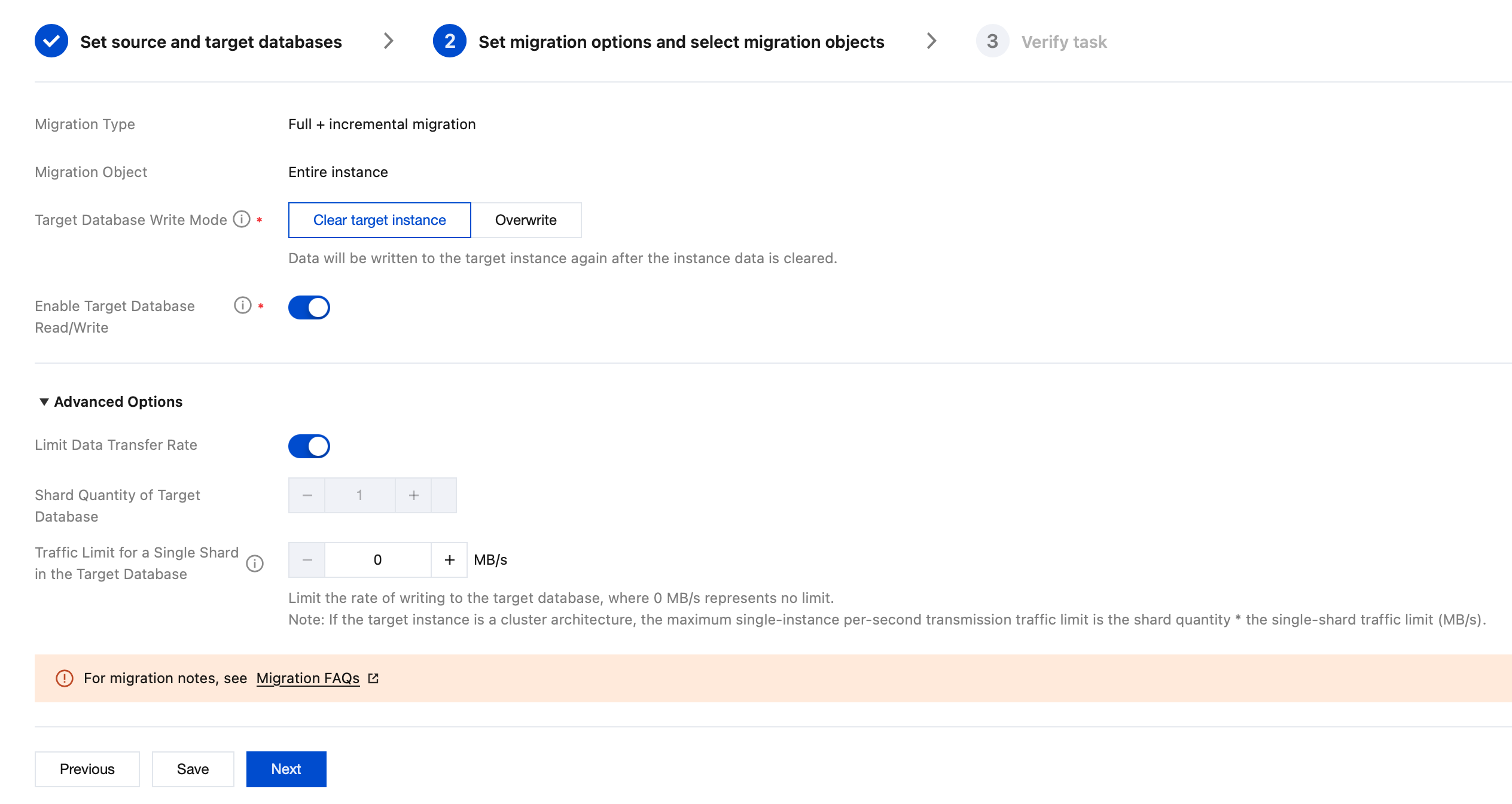
Basic configuration
Configuration Item | Description |
Migration Type | Full + incremental migration is selected by default and cannot be modified. This option migrates both the existing historical data from the source database and any new data added during the migration process. |
Migration Object | The entire instance is selected by default and cannot be modified. |
Target Database Write Mode | Clear target instance: When data is synchronized from the source database to the target database, the existing data in the target database will be cleared and then rewritten. Overwrite: When data is synchronized from the source database to the target database, the data will be updated in the target database by overwriting existing data. For the scenario of migrating data from the cloud to on-premises environments, if Overwrite is not selected in the DTS task configuration, the pre-check will fail when existing data is detected on the target database, and automatic retries will not be triggered. |
Enable Target Database Read/Write | Allow the DTS service or other services to write data to the target database. |
Advanced Options
Configuration Item | Description |
Limit Data Transfer Rate | Generally not required. If the DTS transfer rate causes a performance impact on the target database, you can enable this option. Shard Quantity of Target Database: When the target database is a Tencent Cloud database instance, the number of shards is automatically obtained and cannot be modified. Traffic Limit for a Single Shard in the Target Database: Specify the traffic limit for a single shard. If the target instance uses a cluster architecture, the maximum traffic transmitted per second by a single instance is equal to the number of shards multiplied by the single shard traffic limit (MB/s). |
Step 5: Checking and Starting the Task
1. On the Validation Task page, the system automatically performs a pre-check. After the pre-check passes, click Immediate start to immediately initiate the data migration. If a scheduled execution time was set during task configuration, you may also select Start Later, and the task will start at the specified time.
Note:
If the result is Failed, it indicates that a check item fails, the task is blocked, and you need to resolve the issue and execute the check task again.
If the result is Warning, it indicates that the check items do not fully meet the requirements. The task can still proceed, but business operations may be affected. Users need to evaluate whether to ignore the warning or resolve the issue before continuing, based on the system prompt.
2. In the pop-up Start Migration Task dialog box, click OK.
3. Return to the data migration task list. The task enters the ready-to-run status. After running for 1 to 2 minutes, the data migration task will officially start.
Step 6: Ending the Task
1. If you need to perform operations such as viewing details of task progress or deleting tasks, click the corresponding button in the Operation column. For details, see Task Management.
2. When the task status is preparation completed, it indicates that incremental synchronization is complete and the task can be closed. Click Complete in the Operation column to finalize the migration task.

It is recommended to end the task only when the data gap between the target and source databases is 0 KB and the time gap between them is 0 seconds.
Before ending the task, perform a data consistency check and confirm that the comparison results are consistent.
Note:
It is recommended to perform a full data check or a check of critical business data, with priority given to a complete check. For large data volumes, you can choose a sampling check based on business requirements.
If you need to perform a business cutover after the migration is complete, see Cutover Instructions.
フィードバック